

Custom-built e-commerce platforms and ready-made templates represent the foundational choice every digital founder faces when launching a business. The standard advice you hear everywhere sounds bulletproof: Move fast, keep costs low, and launch with a ready-made template.
It makes total sense on paper. Why spend months writing software from scratch when you can rent a pre-packaged storefront, drop in a few visual themes, and start taking customer orders on day one? For a small side project, a low-risk product test, or a weekend experiment, that approach is a total no-brainer.
However, as a company moves past its initial validation phase and faces the real, everyday pressures of serving a demanding, fast-paced market, a quiet realization sets in. You start noticing that the walls of your rented template have suddenly become the absolute ceiling of your growth.
Choosing the right technical foundation is one of the most critical decisions a founder can make. To answer the core question—which option is truly best for your business?—we need to look past the marketing hype and examine how both choices actually perform under real operational pressure.
The Fundamental Divergence: What Do These Options Actually Mean?
Before comparing performance, cost, and scale, we must clear up a major misconception. Choosing a custom-built infrastructure does not mean you are rewriting database engines, designing your own servers, or building insecure payment processors from a blank screen. Smart engineering relies on leveraging robust, industry-standard infrastructure and verified global services (like certified payment gateways and secure cloud environments) for what they do best.
-
Ready-Made Templates: You rent a slot within a massive, generalized ecosystem. You get a pre-configured dashboard, a rigid layout structure, and access to a marketplace of third-party add-ons to build your features.
-
Custom-Built E-Commerce: You own your core architecture. You use standard tools and secure global services where appropriate, but you retain absolute control over your Core Business Logic and User Experience Layer.
With that baseline established, let’s weigh them across the factors that actually matter.
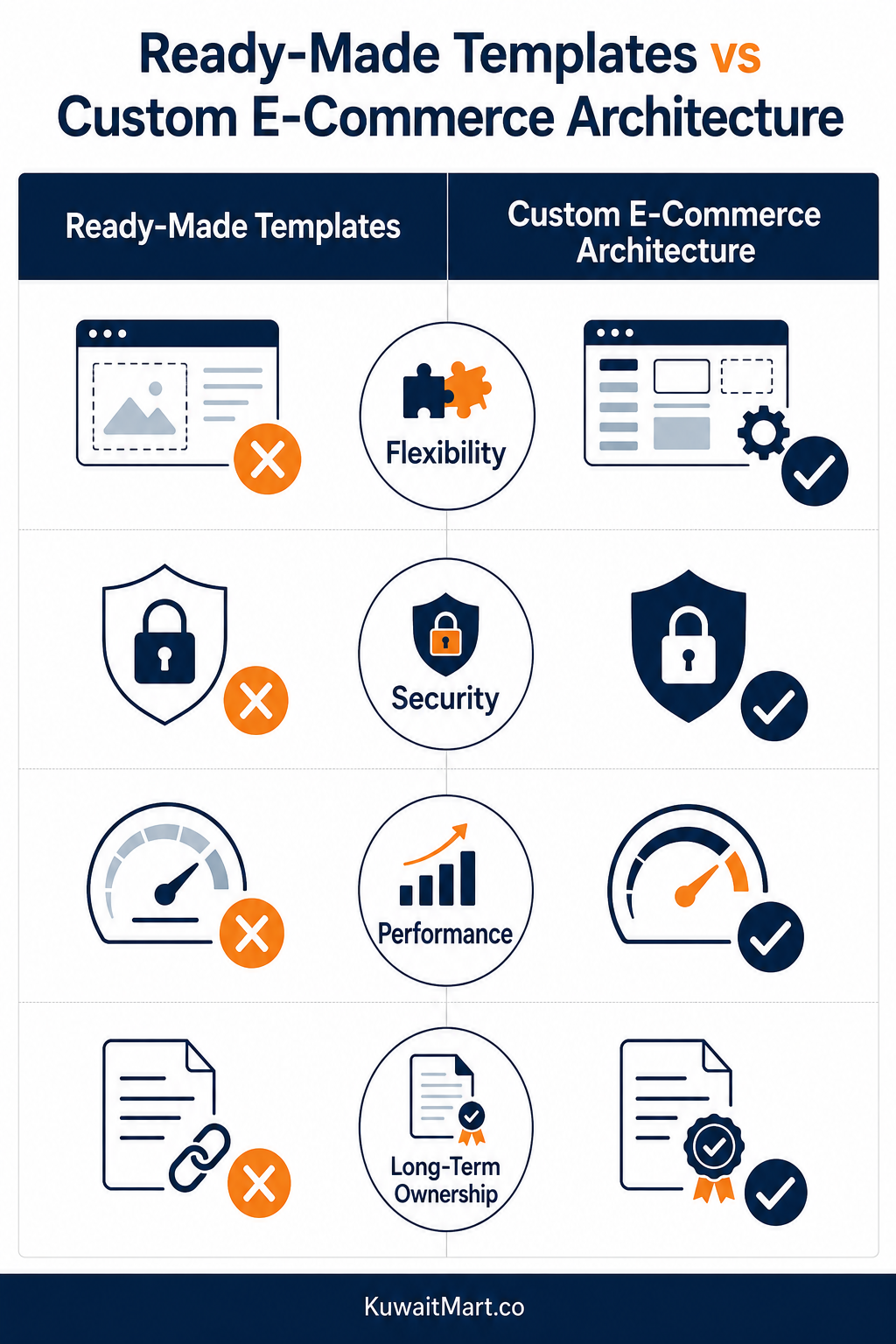
The Myth of “One-Size-Fits-All” Flexibility
Every pre-packaged software framework or ready-made template is built to do one primary thing: appeal to the widest possible global audience.
Think about it. A global template has to serve a million different merchants—from a small boutique selling handmade crafts in Europe to a massive dropshipping store somewhere else. Because it must please everyone globally, it ends up being deeply generic locally.
The moment your business needs to execute specific operational workflows, the friction begins:
-
Ready-Made Templates: You are forced to bend your business logic to fit the software’s rigid rules. If local delivery logistics, regional payment validation, or custom inventory synchronization require a specific flow, you have to search for a third-party plugin or force an awkward workaround.
-
Custom-Built Infrastructure: You write the specific logic that dictates how your operations flow. Every inventory sync, logistical touchpoint, and checkout step is engineered to match how your business actually operates, removing unnecessary friction from day one.
The Security Reality: Managing the “Attack Surface”
A common question business owners ask is: How can a custom setup be secure when global software giants have massive security teams?
The secret isn’t about claiming an independent team is smarter than a multi-billion-dollar corporation. The real vulnerability in standard, ready-made frameworks rarely comes from the core system itself—it comes from the ecosystem of third-party plugins and extensions.
When you use a generic system, you are often forced to rely on thirty or forty different plugins written by independent, unverified developers to handle basic features. Each plugin has its own update schedule, its own hidden vulnerabilities, and its own backdoor access. You essentially build a fragile house of cards where one weak widget can compromise the entire platform.
By building a clean, focused custom stack, you drastically shrink your attack surface. You don’t have dozens of random plugins running in the background because your required features are written natively into a lean, controlled environment. Security isn’t an afterthought patch downloaded from a marketplace; it is built directly into how your system handles data.
User Experience and the Cost of Digital Friction
Modern consumers are smart, fast-paced, and incredibly discerning. When people use a digital platform today, they have zero patience for awkward layouts, slow loading screens, or clunky checkout steps.
Templates dictate how your product pages look, how search results appear, and how a customer moves toward making a purchase. If you want to optimize these flows to match how your customers naturally behave, you find yourself fighting against the software—forcing workarounds, injecting messy scripts, and dragging down your site’s performance.
Customers can feel the difference immediately. They can tell when a brand is just squeezing itself into a generic box versus when an experience has been thoughtfully built just for them.
Owning your entire tech stack means you control every single millisecond of the user journey. If you want to make a checkout step smoother or a page load faster, you don’t have to wait for a global software provider to roll out a global update. You execute it immediately.
The Economics: Short-Term Savings vs. Long-Term TCO (Total Cost of Ownership)
People often assume that building custom software is universally more expensive. While the initial setup cost requires a greater upfront engineering investment, looking at the long-term total cost of ownership tells a very different story.
-
The Hidden Costs of Templates: Costs accumulate silently over time. You pay monthly subscription tiers that scale upward as your traffic grows. You pay for expensive developer workarounds to bend generic software to your needs. You face constant emergency fixes whenever third-party plugins conflict, alongside lost revenue during unexpected downtime caused by external server outages.
-
The Value of Custom Assets: When you invest in your own custom stack, every dollar goes toward building a real digital asset that belongs entirely to your company. Your team spends its time improving features and creating real value rather than constantly debugging other people’s code.
Managing Continuity and the “Key Person” Risk
Another valid concern raised about custom software is continuity: What happens if the original developer leaves? Does the whole project grind to a halt?
That is a very real risk for any company that relies on messy code written by a single programmer. However, professional custom engineering solves this through Clean Architecture and Rigorous Documentation.
A proper custom system is built following strict global engineering standards, structured code patterns, and clear documentation. It is designed so that any qualified, professional engineering team can read it, maintain it, and scale it seamlessly. Your operational stability does not rely on a single person’s memory; it relies on institutional code quality.
The Verdict: Which Is Best for Your Business?
So, back to the core question: Which option is best for your business?
If your ambition is to run a temporary storefront, test a fleeting trend, or operate a low-volume side project that mimics hundreds of others in the market, ready-made templates are the practical, efficient choice. They get you to market quickly with minimal friction.
However, if your goal is to build a robust, scalable digital institution capable of evolving securely alongside market demands without external bottlenecks, custom-built e-commerce is the only viable long-term path.
The shortcuts might save you a few weeks at the beginning, but it is the solid, custom foundation you build with absolute clarity that determines how far your business can actually go.
A Real-World Example: Why We Chose Custom at Kuwait Mart
This is precisely why, at Kuwait Mart, we deliberately chose a custom-built architecture rather than a standard template. As our platform scaled, having total control over our source code, integrations, and user experience allowed us to deliver a seamless, high-performance shopping environment, entirely free from the performance bottlenecks and hidden limitations that typically plague template-based stores.

Co-Founder & CEO of Kuwait Mart. An Electrical Engineer focused on building scalable e-commerce operations and driving digital growth in the Kuwaiti market.