

Flexibility vs. Governance is the core tension every founder faces: imagine the scene on day one; the idea is burning in your head, excitement fills the small space where you gathered with your co-founders, and the sole objective is crystal clear: survival, execution, and speed.
In this early phase, nobody has the luxury of drafting complex policies, and nobody wastes a minute drawing strict organizational charts. Agreements are sometimes made on a “handshake” or over a meal, and decisions are locked in within seconds. This state of “creative chaos” or absolute flexibility isn’t a flaw—it is the fuel of any startup. It allows founders to pounce on opportunities and adapt instantly to market shifts before slower legacy giants can even react. According to the landmark data analysis on startup failures by CB Insights Research on Why Startups Fail, over 38% of startups fail due to cash depletion and the inability to sustain operations, while a staggering 43% fail because of poor product-market fit—proving that early hyper-agility, rapid pivoting, and speed of execution are literal matters of life and death.
Yet, what happens two or three years down the road? When the team scales, operations multiply, and fresh capital enters the boardroom? Suddenly, small cracks appear on the surface: Who holds the final signing authority? Why are co-founders disagreeing on role divisions or profit-sharing? Why does every critical decision depend entirely on the “mood” or presence of just one person?
This brings us to the ultimate dilemma shaking the foundations of any startup: Do we stick to flexibility and speed and ignore structure? Or do we implement governance and risk killing the innovation and velocity that built our entity in the first place?
The Lifeline of Agility
To be fair and realistic, flexibility isn’t just an option in a company’s first year—it is the ultimate lifeline.
When you launch your venture, you are competing in a ruthless commercial market. You need to pivot your product or service within hours based on real feedback from your very first customer, make bold marketing calls instantly without committee approvals, and allocate tasks based on immediate execution rather than rigid job titles. Research on entrepreneurial execution principles compiled by Y Combinator’s Startup Library Insights highlights that fast-growing early-stage teams that maintain fluid operational communication outperform rigid corporate competitors by up to 35% in speed-to-market and deployment velocity.
However, absolute flexibility has a strict expiration date. Much like a toddler who needs absolute freedom to explore, unmanaged freedom as the company scales quickly morphs into destructive chaos.
The Hidden Nightmare of Unmanaged Chaos
In startups, the symptoms of “expired flexibility” surface through unmistakable warning signs:
-
Blurred Responsibilities: When an operational error occurs, everyone points fingers because the task was never anchored to a specific person or mechanism. The underlying rule becomes: “What belongs to everyone is the responsibility of no one.”
-
“Patchwork” Decisions: Relying entirely on personal ties and verbal agreements among founders. The moment a financial crunch hits, the company lacks a legal reference point to safeguard rights. Legal analysis and structural frameworks provided by SeedLegals Guide on NVCA Model Legal Documents indicate that nearly 60% of early-stage founder disputes and equity breakdowns stem directly from informal, undocumented initial agreements. Additionally, research shows that over 65% of high-growth startup failures are rooted in co-founder conflict rather than bad market conditions.
-
Growth Bottlenecks: Serious institutional investors walk away instantly if they see a company managing its finances purely on gut feeling, with zero transparency on cash flow or decision-making authorities.
This is when the conscious founder realizes it is time to transition—cautiously and professionally—to the next phase: engineering structure and governance.
The Startup Lifecycle (From Chaos to Institution)
To visualize the overarching picture, every successful business traverses three core stations on its journey:
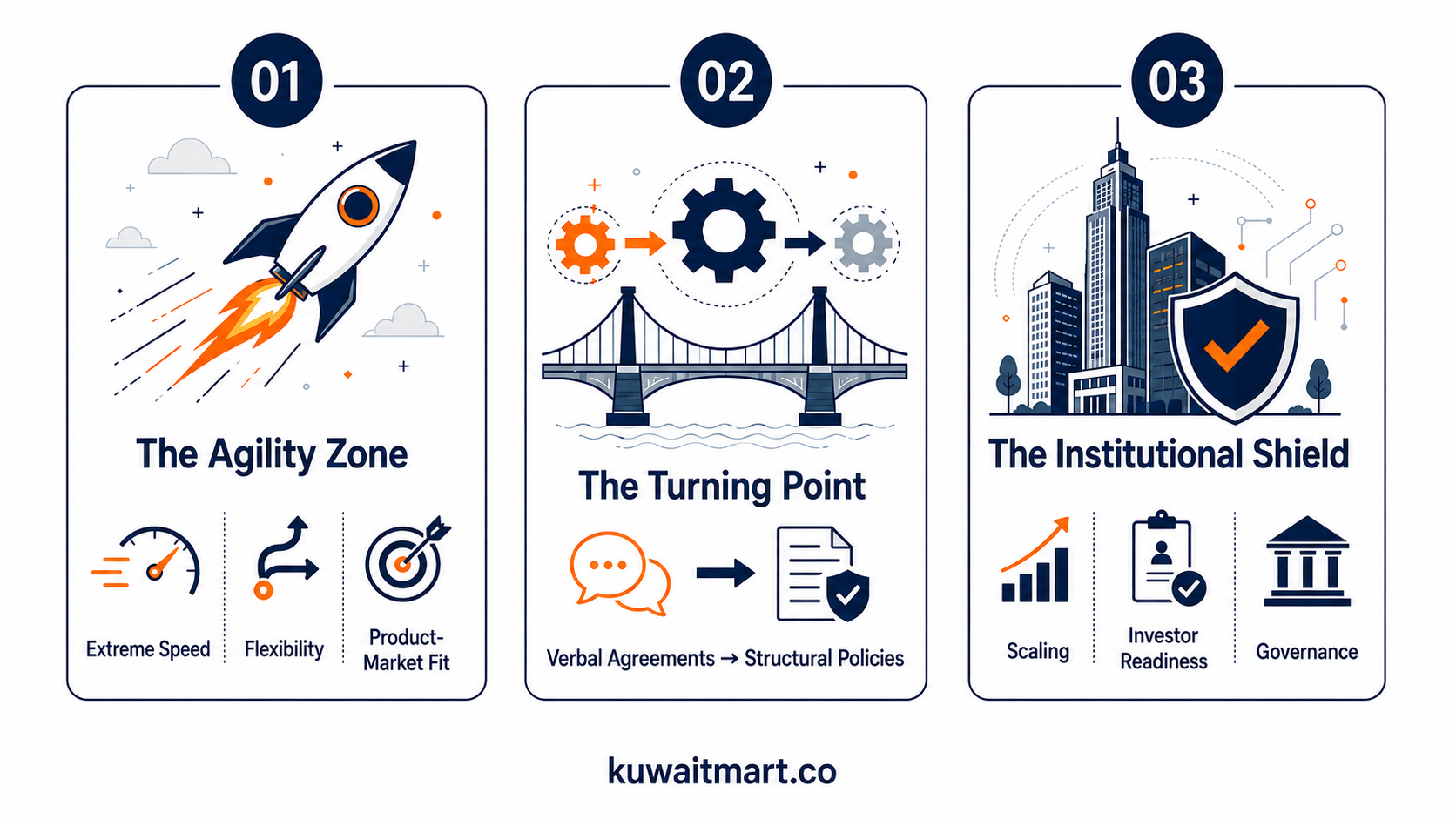
What Actually Is Governance? (And Why Do Founders Fear It Wrongly?)
When many people hear the word “Governance,” images of massive banks and towering paper binders signed by high-priced lawyers instantly flood their minds. This exact misconception drives startup founders away.
Yet governance, in its simplest startup-oriented definition, is nothing more than:
“Clear rules of the game ensuring everyone knows their role, company funds are secure, and decisions are made for the sake of the enterprise rather than personal moods.”
Governance in a startup does not mean slow bureaucracy. According to global regulatory frameworks outlined in the OECD Corporate Governance Factbook, implementing light-touch structural governance for growing business entities increases external investment readiness and valuation appeal by nearly 50%. It means establishing a complete firewall between company funds and personal founder funds, ensuring every partner knows their decision-making boundaries, and keeping financial reports transparent.
When Should a Smart Founder Shift From One Phase to Another?
The fatal mistake some founders commit is swinging to extremes: rejecting governance entirely and running a multi-million-dollar operation like a corner shop, or preempting reality by implementing heavy corporate bureaucracy in their first six months.
The successful founder acts as an “engineer” who knows when to wear a hard hat and when to run. This transition doesn’t happen overnight; it is a phased approach scaling naturally with revenue growth and team size. When verbal agreements can no longer safeguard operational scale, that is your yellow light to organize things before it turns red.
A Future Vision from Kuwait Mart’s Perspective
Ultimately, running a startup closely mirrors steering a ship through choppy waters. In the beginning, you need brute rowing power and rapid maneuverability. That is launch flexibility. Yet, for that ship to transform into a commercial flagship crossing oceans steadily, the day must come when a clear compass is engineered.
Here at Kuwait Mart, as we scale rapidly across the market through innovative e-commerce solutions fueled by a young, energetic national team, we live by this exact formula: speed and flexibility are the launch fuels that ignite momentum, but awareness of governance and deliberate structural planning remain the true compass for future sustainability. Building a trusted digital entity is never left to chance; it is a conscious journey of executing the right moves at the exact right time.

Co-Founder & CEO of Kuwait Mart. An Electrical Engineer focused on building scalable e-commerce operations and driving digital growth in the Kuwaiti market.