

When looking at the day-to-day costs of running an online store in Kuwait, most business owners focus on marketing expenses or website hosting fees. But if you take a closer look at your financial reports, you will notice a silent drain on your revenue happening at the very last step of every sale: the high fees charged by payment collection middlemen.
Market research from platforms like DataReportal shows that Kuwait’s digital economy is booming, with internet usage rates sitting consistently between 99% and 100%. Meanwhile, retail and fintech reports (such as those from Research and Markets) value the local e-commerce market at approximately 1.95 billion dollars, with strong, steady growth projected for the coming years.
Despite this massive growth and high customer readiness, most online stores still rely heavily on third-party payment aggregators. While these middlemen offer a quick and easy setup when you are just launching your business—much like using standard templates before upgrading to a custom-built website, as we discussed in our guide on custom e-commerce versus templates—they create major long-term roadblocks for your cash flow and net profits.
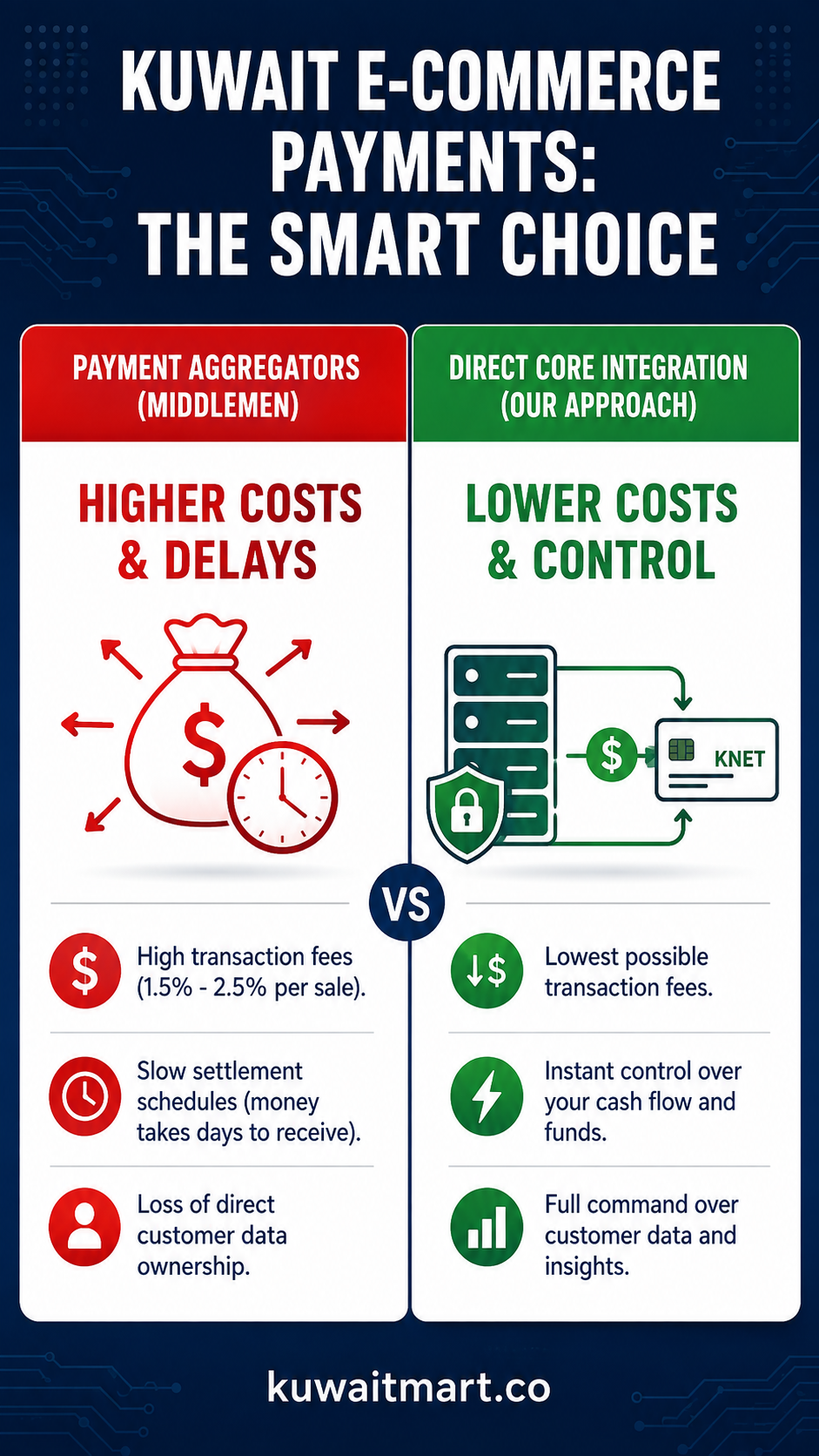
The Real Cost of Middlemen: How Profits Shrink
When running a business, every transaction fee matters. Because a huge portion of online payments in Kuwait goes through standard bank cards and clearing channels, relying on third-party processors creates immediate financial pressure:
-
Shrinking Profit Margins: Third-party payment providers typically take 1.5% to 2.5% plus fixed per-transaction fees. In retail where profit margins are already tight, this deduction eats up a big chunk of what you actually earn.
-
Delayed Cash Flow: Middlemen often hold onto your money under strict settlement schedules. Financial guidelines from major institutions (such as McKinsey & Company) advise keeping your cash liquid so you can reinvest it quickly into inventory and growth.
-
Losing Customer Data: When someone else processes your payments, you lose direct control over valuable customer data, making it harder to track buying habits and fix checkout drop-offs.
Security Rules (PCI-DSS) and Safety Risks
How you handle payments also affects your website’s overall security and stability:
-
Security Compliance: Handling payments directly means meeting strict security rules, like the Payment Card Industry Data Security Standard (PCI-DSS) managed by the PCI Security Standards Council. Using aggregators lets you skip these setup steps, but it leaves your store dependent on someone else’s security measures.
-
The Danger of a Single Point of Failure: If your payment middleman experiences technical issues or downtime, your entire checkout process stops working instantly—an operational risk highlighted in technology and infrastructure studies by Gartner.
The Smart Move: Switching to Direct Payment Integration
To build a truly sustainable and independent business, online stores should move away from temporary workarounds and connect directly with core banking infrastructure:
-
The National Clearing Network (KNET): The trusted backbone for local debit card payments in Kuwait, operating under the rules and supervision of the Central Bank of Kuwait.
-
Global Card Schemes (Visa & Mastercard): Direct channels for handling credit and international cards.
Going direct brings massive benefits to your business:
-
Lower Transaction Costs: Bringing your per-transaction processing fees down to the minimum possible rate.
-
Total Control Over Cash Flow: You decide when and how your funds move without waiting on third-party schedules.
-
Better Flexibility: Customizing your payment flow to match your exact business needs.
Our Perspective at Kuwait Mart: Building for Independence
When we established Kuwait Mart, our goal was clear: remove unnecessary operational inefficiencies. We realized early on that relying on default payment intermediaries eats away at long-term growth and profits.
That is why our technical and financial strategy has always focused on building a proprietary system that connects directly with core clearing networks. By integrating directly with the right financial channels, we keep full control over our transaction data, cash flow speed, and overall efficiency—without relying on outside middlemen.
Conclusion
Kuwait’s digital market is maturing rapidly, creating a clear split between businesses. Stores stuck using rented infrastructure will continue dealing with high costs and limited growth, while companies that invest in true technical independence will secure the profitability and efficiency needed to lead the market.

Co-Founder & CEO of Kuwait Mart. An Electrical Engineer focused on building scalable e-commerce operations and driving digital growth in the Kuwaiti market.